 This week’s Featured Language Professional is Francesca Manicardi, an interpreter, translator, and mentor. With over 15 years of experience in the T&I industry, Francesca has not only built a successful freelance career but also founded The Freelance Lab, Italy’s first mentoring program for aspiring linguists.
In LEO’s exclusive Q&A, Francesca shares her journey of overcoming the challenges of freelance life, including the unexpected demands of self-employment, from managing invoices to marketing services. We also discussed her passion for helping new linguists navigate these hurdles through mentoring and filter-free training on essential business skills.
LEO: As the founder of The Freelance Lab, Italy’s first mentoring program for aspiring interpreters and translators, what motivated you to start this initiative, and what do you think is the most valuable skill new linguists need to develop?
 Francesca: When I started out as a self-employed interpreter and translator, I assumed I’d spend my days fully immersed in interpreting and translation assignments. It was a shock to realize I also had to handle invoices, taxes, legal matters, project estimates, preparing quotes, countless emails, and even marketing my services. Most of all, I was struck by the fact that no one had warned me about these behind-the-scenes responsibilities.
 It was tough learning everything the hard way, but it made me determined to help fellow interpreters and translators avoid the same struggles. I wanted to provide filter-free training on the many hats we wear as freelancers, as well as mentoring services for those who don’t know where to start.
One of the biggest challenges in our industry is low rates, yet no one seems to explain to newcomers why this approach isn’t sustainable in the long run. When I first entered the industry, I didn’t know what rates to charge and assumed, like many beginners, that lowering my rates and being available 24/7 would make me more competitive and help me secure more assignments. I was completely wrong. I had to learn through trial and error how to handle these challenges.
With The Freelance Lab, I wanted to address these issues head-on, including topics like money and rates, because I firmly believe that building skilled and informed future generations of colleagues who understand their worth benefits us all.
 I’ve been there, and I know how lonely this industry can feel. I also know how hard it can be to find experienced colleagues willing to share advice and tips. That’s why I wanted to be that supportive older colleague—offering not only practical guidance but also emotional support.
L: With over 15 years in the T&I industry, what are the most significant changes you’ve seen in the profession, and how have they impacted freelancers specifically?
F: I started my career shortly after the collapse of Lehman Brothers, which brought down the entire economy. It was incredibly challenging to stand out and make a living in interpreting and translation. Although it wasn’t easy, and it took me a few years to work full-time as an interpreter and translator, I consider that period a tough but invaluable training ground.
 Just as things began to improve, COVID-19 hit. While the pandemic brought numerous challenges, it also accelerated the growth of remote interpreting. Although remote interpreting existed before, after 2020, we saw increasingly accurate apps and software that enabled us to carry out assignments from virtually anywhere.
And, of course, I must mention the significant advancements in AI. I believe AI has the potential to enhance our work and make it more efficient. Those who embrace and master these tools will undoubtedly find greater success than those who choose to ignore them.
L: What common challenges do you see freelance translators and interpreters facing today, and how would you advise them to navigate these challenges?
F: The growing presence of AI tools is undoubtedly one of the biggest challenges facing interpreters and translators today. Convincing customers that human translation and input are still essential is critical. While this isn’t easy — especially for those who don’t fully understand the value of our work — I believe it’s only a matter of time before this becomes more widely recognized. In the meantime, staying updated with new technology and building strong personal branding that reflects our values and worth is what sets professionals apart.
It’s also disheartening that our profession lacks official recognition in many cases. For example, in Italy, wedding interpreters are often viewed as equivalent to anyone who happens to speak a foreign language. Professional associations are crucial for amplifying our voice and advocating for our role, though there’s still a long way to go.
 While I don’t have an easy solution, I do my part by educating others about the critical importance of professional interpreters. For instance, as a wedding interpreter, I often emphasize that couples want their wedding day to be perfect. Why entrust such an important occasion to someone who only knows a few words in a foreign language when they could rely on a seasoned professional with years of experience? This reasoning typically resonates and helps clients understand the value of investing in a professional interpreting service. 🙂
L: As a member of multiple professional associations, including the Italian Interpreters and Translators Association and the Chartered Institute of Linguists, how have these affiliations influenced your career, and what would you recommend to other freelancers considering joining professional organizations?
F: Professional associations are currently one of the only ways we can protect our profession and amplify our collective voice. They provide valuable opportunities for networking with colleagues, collaborating on projects, finding support, and discussing challenges. Additionally, they offer access to specialized courses and professional training. Perhaps most importantly, being part of an international professional association allows us to stay ahead of emerging trends that may not yet be common in our country.
When I first started my career as an interpreter and translator, I assumed these associations were only for seasoned professionals with extensive experience. However, after speaking with a member, I realized the importance of joining a professional association, even as a newcomer with limited experience. This motivated me to research and join the associations that aligned best with my needs.
From both an institutional and personal perspective, being part of an interpreters and translators association has been invaluable. It provides a sense of belonging and reassurance that I’m not alone in navigating the challenges of our industry—and that in itself means a lot!
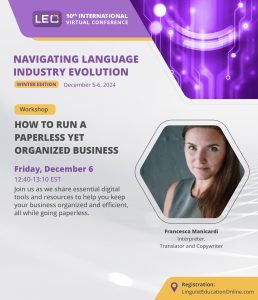 L: In your LEO10 session, “How to Run a Paperless Yet Organized Business,” you’ll be sharing tools and resources for freelancers. Could you give us a sneak peek of one tip or tool that has been particularly effective in helping you stay organized?
F: My journey toward a paperless business began almost unintentionally when I decided to invest in professional tools and purchased a Mac. I was amazed at how much easier it made everything! I immediately started exploring its features and quickly fell in love with iCloud and the seamless synchronization across all my Apple devices — I genuinely can’t imagine working without them now.
The first app I started using was iCal, which became the central tool for managing both my personal and professional life. It has been a game-changer in keeping everything organized.
But I don’t want to give away all the tips and tools I have planned for the conference. Trust me — you won’t be disappointed! I promise to share plenty of practical and valuable insights to help you streamline your workflow.