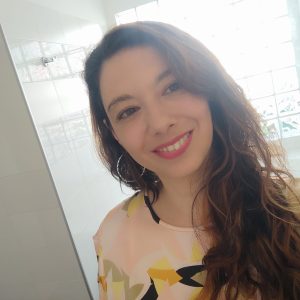
 Meet Florencia Russo, a certified Spanish-to-English translator and technology advocate whose career bridges the gap between language and digital innovation. Based in Argentina, Florencia brings over a decade of experience in technical translation for the automotive, oil & gas, and tech sectors. She also plays an instrumental role in supporting fellow translators by leading the Commission on Computer Tools at the Association of Certified Translators of La Plata.
In this interview, Florencia shares how her passion for technology started at age 15, what excites her about AI and digital tools, and why the industry must embrace continuous tech literacy training.
Q: What first drew you to the field of translation, and how did that path evolve into your passion for technology?
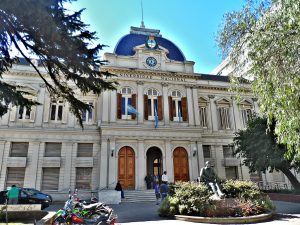
A: My journey into translation began with an early love for international literature—reading Dostoevsky at age 9 and my first exposure to a foreign language at 6. When choosing a career path, translation studies appealed to my naturally curious personality and desire to explore diverse fields of knowledge. This led me to pursue English-Spanish Translation Studies at the University of La Plata in Argentina.
My relationship with technology started at 15, when I chose a computer (a 386) over a traditional birthday celebration. By 16, I had created my first digital dictionary using basic programming languages, marking the beginning of merging my twin passions: translation and technology.
As technology advanced, so did my enthusiasm for applying it to translation work. Eventually, I began teaching translation technology to colleagues, which deepened my commitment as I helped others become more productive and competitive in the field. This combination of linguistic expertise and technological innovation has defined my professional journey.
Q: You specialize in highly technical fields like automotive and oil & gas. What do you find most rewarding and most challenging about working in these industries?
A: The most rewarding part is feeling that I am contributing—even as a small link—to significant industrial advancements. Whether it’s translating documentation involved in the assembly of a car that I later see on the streets or technical documents related to oil drilling operations that have countless practical applications, it feels genuinely satisfying.
The main challenges involve specialized terminology and effective communication with industry professionals, ensuring accuracy and clarity despite highly technical contexts.
Q: What digital tools or workflows are game-changers for translators right now, especially with AI evolving so rapidly?
A: Beyond the usual AI-powered translation tools, recent advances in speech-to-text technologies, automated transcription, and sophisticated corpus analysis tools are radically altering translator workflows. Additionally, the integration of predictive text analytics and real-time linguistic style adaptation is making personalized and context-aware translation increasingly feasible, significantly enhancing translator creativity and efficiency.
Q: What are some common misconceptions professionals have about using technology in their work, and how do you help them overcome resistance or overwhelm?
A: One significant misconception is viewing technology solely as a complicated accessory rather than an integral part of modern translation practice. Many translators underestimate the intuitive nature of today’s technology and assume it requires extensive technical skills.
To counteract this, professionals can be helped to recognize that technology simplifies and enhances their workflow rather than complicating it. By breaking down technological concepts into relatable analogies, offering bite-sized learning sessions, and fostering a supportive learning environment, translators can be empowered to comfortably integrate these tools into their daily work. This should be included in translation training programs, for sure.
Q: How has your work with the Commission on Computer Tools shaped your understanding of what translators really need in today’s tech-driven landscape, and what trends do you think professional associations should be paying closer attention to right now?
A: My experience with the Commission on Computer Tools highlighted how much uncertainty and limited awareness still exists—even among younger generations born into a technological era.
Current educational approaches can be quite traditional and often fail to motivate translators to adapt and acquire new skills. Therefore, professional associations and institutions have a crucial role in helping translators navigate today’s rapidly evolving landscape of technologies, AI, client expectations, tighter deadlines, and diverse text types. Associations should particularly focus on fostering continuous training in technological literacy, emphasizing flexibility and adaptation to ongoing changes.
Q: What is your favorite book and/or movie?
A: This is a difficult question! If I must choose, for books, I’d pick The Lord of the Rings saga, which captivated me long before it became famous through the films. Regarding movies, I particularly love The Green Mile.
 Q: What is your favorite dish?
A: As a proud Argentinean, I have to say my favorite dish is undoubtedly asado (traditional Argentine barbecue).
Q: Favorite place in the world?
A: My favorite place in the world is Scotland. Its landscapes, history, and culture have always fascinated me.
Q: Favorite quote?
A: “Success is not final; failure is not fatal: it is the courage to continue that counts.” – Winston Churchill
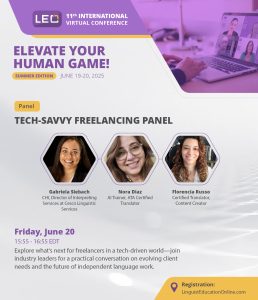 Q: At LEO11, you’ll be joining Nora Díaz and Gabriela Siebach on the Tech-Savvy Freelancing panel. What topics are you most excited to dive into, and what do you hope attendees will take away from the conversation?
A: I’m especially looking forward to discussing how translators can overcome their fear of technology and the common misconception that adopting new tools requires excessive time and effort. Many translators hesitate to integrate technology into their workflows because it seems intimidating or overly complex, but my experience has shown that it’s often easier—and more beneficial—than they expect.
One key idea we’ll explore is the concept of workflows as a balanced collaboration between humans and technology. While artificial intelligence excels at handling isolated, repetitive tasks, it doesn’t yet have the capability to manage the nuanced, interconnected processes translators face daily, such as client-specific preferences, stylistic judgment, and cultural considerations. Human translators still play a critical role in maintaining the quality, accuracy, and nuance of professional translation services.
Instead of viewing technology as a wholesale replacement, we need to approach it as a strategic partner. The best workflows today integrate AI and automation within human-guided processes. By thoughtfully selecting and adapting tools to complement our strengths, translators can reduce tedious tasks, increase productivity, and improve overall job satisfaction. My goal for attendees is that they leave our panel feeling empowered and equipped to start leveraging technology confidently, recognizing its value as a supportive partner rather than a replacement.