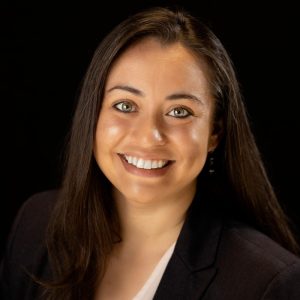
 Gabriela Siebach is an Adjunct Professor at UMass-Amherst and the Director of Interpreting Services at Cesco Linguistic Services. With two decades of experience in training, assessment, and advocacy, Gabriela has dedicated her career to advancing equitable language access. She holds a graduate degree in Spanish Translation and Interpretation from the Middlebury Institute of International Studies at Monterey.
A former Board Member of the National Council on Interpreting in Health Care (2019–2021), she currently chairs its Policy, Education & Research Committee and co-chairs the Interpreting and Translation in Education Workgroup’s Job Task Analysis Committee. Gabriela also serves on the ATA Government Division Leadership Council and is active in CATI, ASTM, and NAJIT.
She’s a passionate advocate for professional development and believes the T&I field is always evolving, just like language itself.
In this candid Q&A, Gabriela shares what first drew her to interpreting, how her military background shaped her professional lens, and why grit and community matter more than ever. Whether you’re a student, a working interpreter, or a leader in the field, her insights are equal parts honest, empowering, and inspiring.
Q: What originally drew you to the language access field, and what continues to inspire your work today?
A: Like many in our profession, I started by accident. I did not know interpreters and translators existed outside of the “as seen on TV” realm. I would sometimes glimpse interpreters on the news or hear them doing voiceovers on the radio and think, wouldn’t it be great if we, regular people, had access to this service too? I was a child interpreter, not because I loved it, but because I felt that I had no other choice. When I discovered that you could use language skills to earn a living, I jumped on the opportunity. When I discovered that language access was a right and available to all, I made it my passion. I am motivated, engaged, and inspired to continue in this profession not only because it is so rewarding and provides me with the opportunity to use my language skills, but also because it helps me protect other children from the pressure and stress of having to interpret for their parents. I do it, so they don’t have to.
Q: Serving as a linguist in the U.S. Army is a unique starting point for a civilian interpreting career. How was it to transition from military to community or educational interpreting?
A: Well, it was interesting, to say the least. To be honest, while I learned so much from serving in the military, the truth is that the work that I did as a linguist was completely different from the work of a translator and interpreter. As a linguist, I was taught to “gist” information, or provide summaries of one or multiple source files. While those tasks prepared me to be able to analyze source content and fully decipher its meaning, they did not prepare me to complete a full reformulation of the message in the target language. After completing my military service, I was very fortunate to work with an experienced colleague who took me under her wing and helped me develop the reformulation skills I was lacking. I also had to complete additional training and eventually even academic schooling. Honestly, I continue to practice and train to continue to develop these skills. What we do is very complex and requires constant training and practice.
Q: With over 15 years of experience, how have you seen the industry evolve, and what changes do you think are still urgently needed?
A: I will hit my 20 years in this profession this year. Great question. Yes, the industry has evolved, and so has our profession. In the last 20 years, we have seen how our industry has been disrupted, more than once, by technological advancements. Some have been driven by improvements in technology itself, but others have been driven by need. For example, while we had the technology and capabilities to offer remote interpreting services in all settings when I entered the profession, it wasn’t until the pandemic forced many of us to adopt the new technology that it completely changed the landscape. We continue to see technological advancements, like the emergence of AI, that promise to “replace” human talent, but as we have seen with past technological advancements, I foresee a rise in the use of the new technology while end-users learn its true capabilities, followed by a drop driven by disillusionment. However, I also believe that there is a place for these technologies, in their current state, in our industry, and as long as we stay abreast of their capabilities and limitations, we will be prepared to find our very own place in the industry. Because I know there will continue to be a place for human interpreters and translators in our industry. We just have to be ingenious enough to find or develop it.
Q: Through your roles in organizations like NCIHC and ATA, you’ve had a front-row seat to policy-making and standard-setting. What’s one lesson you’ve learned about turning interpreter feedback into real-world change, and what advice would you give professionals who want their voices heard?
A: As language professionals, we are often on the sidelines, right? Others communicate with each other through us, but our own voices are not often heard. We are also generally taught that we should not allow our own thoughts and ideas to be reflected in our work. You cannot truly respect communicative autonomy if you change the style, the message. Sometimes, we forget that this only applies to the interpreted conversation or the translation we are completing. Yes, I volunteer for multiple professional organizations, and I have seen how instrumental their initiatives are to promoting policy changes. However, their work is only possible thanks to individual action. Individual members pay their membership dues, which are then used to carry out these initiatives. Individual members volunteer their time and talents to make these initiatives possible. Individuals are behind every initiative. So, what is my advice? Do something. If you can, voice your own thoughts and ideas to stimulate change, but do it after thoroughly understanding an issue. We have a great example from a colleague down in Florida who advocated for language access in the courthouse where she was employed. She was fired, and she did not stop there. She sued for wrongful termination and won. However, I know that this may be outside of our comfort zone and requires that we have a lot of base knowledge and background information, but we can also start by volunteering our time for local professional organizations. No time? No problem. Simply join an organization, let others take your membership fees, and make that positive change you are not quite sure how to make. If you see something that needs changing and don’t know how to change it, tell your professional organization.
Q: You work closely with students as an educator while also leading interpreter services in the field. What do you believe today’s students need most—not just to enter the profession, but to thrive and lead within it?
A: Easy. Grit. A colleague recently recommended a book by Angela Duckworth titled “Grit: The Power of Passion and Perseverance.” Since we are living through another moment of disruption and uncertainty in our industry, as I read it, I felt like it was talking to all of us, new and seasoned in the profession. In the book she talks about how important perseverance and the desire to succeed are to actually achieving success; she mentions that they are more important than natural talent. I think that students entering our field need exactly that: a deep-rooted desire to succeed and passion for the work that we do. They need to have a reason so strong for wanting to join our ranks that they will not be easily discouraged by the work itself or any current or future disruption we encounter. They need to be willing to do whatever it takes to be more than just good enough.
Q: What is your favorite book and/or movie?
A: I think that to answer this question, I must first clarify that I seldom read to improve myself. I read primarily for pleasure. I think that as a linguist, reading is important. It is like language maintenance, and what you read is not as important as ensuring that you are always reading. My favorite author is Tess Gerritsen. She writes crime fiction, and I get absorbed in her novels. I can’t pick just one, but from her Rizzoli and Isles series, my favorites are Body Double and Ice Cold.
 Q: What is your favorite dish?
A: I love food. I will try anything at least once. However, my favorite dish is sopes, a Mexican dish comprised of a “scoop” made out of corn flour filled with your preferred protein and toppings. I like refried beans, chicken tinga (chicken in a chipotle red sauce), cheese, lettuce, tomato, and hot sauce.
Q: Favorite place in the world?
A: This is probably a lame answer, but my favorite place in the world is my home. I am a total homebody who loves being at home, tending to the garden, cooking, eating, reading — doing anything, really.
Q: Favorite quote?
A: Insanity is repeating the same mistakes and expecting different results (Narcotics Anonymous, 1981). As interpreters and translators, sometimes we fool ourselves into thinking that because we interpret or translate day in and day out, we will magically improve. The point that the Narcotics Anonymous publication was trying to make is that we cannot overcome addiction on our own. As interpreters and translators, we also cannot improve on our own; we need additional resources, like colleagues and reference materials, to evolve our technique and linguistic command. And I try to live what I teach by attending training events and reading to continue to improve my skills and develop my language proficiency.
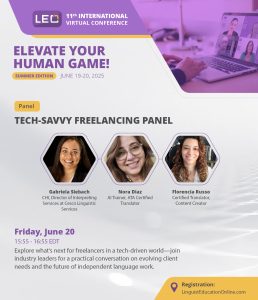 Q: At LEO11, you’ll be joining Nora Díaz and Florencia Russo on the Tech-Savvy Freelancing panel. What topics are you most excited to dive into, and what do you hope attendees will take away from the conversation?
A: I am very excited about the opportunity to share a panel with Nora Díaz and Florencia Russo. They are both very knowledgeable colleagues, and I know I will learn a lot. The specific domain I am excited to dive into is that of machine interpreting or AI interpreting and what tech-savvy freelance interpreters should know about current technological capabilities. There is so much noise about AI and AI interpreting in particular, and I think many of us are not quite sure what to think. I look forward to discussing current capabilities and how interpreters can set themselves apart in an ever-evolving industry.